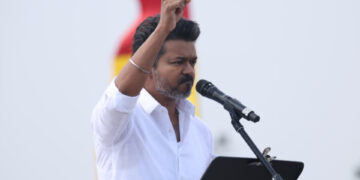



















In the sweltering heat of southern India’s political heartland, tragedy has become an unwelcome companion to the roar of crowds. On September 27, 2025, a massive rally for actor-turned-politician Vijay’s Tamilaga Vettri Kazhagam (TVK) party in Karur district turned deadly, claiming 39 lives – including nine children and 17 women – in a chaotic stampede. As families mourn amid scattered shoes and crumpled banners, this incident marks the deadliest in a series of crowd-related disasters plaguing Tamil Nadu over the past four years under Chief Minister MK Stalin’s Dravida Munnetra Kazhagam (DMK) government. Critics are sounding alarms over systemic failures in crowd management, demanding accountability before the next gathering spirals out of control.
The Karur catastrophe unfolded around 7:45 p.m. local time, as tens of thousands of Vijay’s fervent supporters – drawn by the star’s magnetic pull – packed a two-kilometer stretch along the Karur-Erode highway. Eyewitnesses described a perfect storm: Vijay’s convoy arrived nearly six hours late, swelling an already overheated crowd that waited without adequate water or shade. When the actor finally took the makeshift stage atop his campaign bus, panic erupted as fans surged forward, trampling dozens in the crush. “People were choking; children were screaming,” recounted a survivor from Karur Government Medical College Hospital, where 51 others remain in intensive care.
Chief Minister MK Stalin, who visited the site on Sunday morning, called it “an unprecedented tragedy in our state’s political history,” announcing Rs 10 lakh ($11,900) compensation for each deceased family and Rs 1 lakh ($1,190) for the injured. He ordered a judicial probe led by retired High Court Justice Aruna Jagadeesan, vowing “strict action” once findings emerge. Yet, as bodies were handed over to grieving families after post-mortems, questions linger: Why were permissions granted for only 10,000 attendees when 27,000 appeared? Where were the reinforcements to prevent the inevitable?
This is not an isolated horror. Since Stalin assumed office in May 2021, Tamil Nadu has witnessed a chilling pattern of stampede deaths at public events, religious festivals, and political spectacles – totaling at least 75 lives across five major incidents. Data compiled from state health reports, National Crime Records Bureau (NCRB) statistics, and eyewitness accounts paint a grim picture of recurring lapses: insufficient police deployment, poor venue planning, and reliance on ad-hoc responses rather than proactive safety protocols.
| Date | Incident | Location | Deaths | Injuries | Key Details |
|——|———-|———-|——–|———-|————-|
| October 3, 2024 | IAF Air Show Crowd Crush | Chennai Marina Beach | 5 | 200+ | Exhaustion and heatstroke amid 1.5 million attendees; opposition slammed “poor planning” and inadequate transport. |
| January 8, 2025 | Temple Free Pass Rush | Unspecified Temple, Tamil Nadu | 6 | Dozens | Devotees stampeded for ritual passes; lack of barriers cited. |
| January 29, 2025 | Hindu Festival Crowd Crush | Uttar Pradesh-Tamil Nadu Border Festival | 37 (TN victims: 12) | 100+ | Overcrowded ghats during holy dip; Tamil Nadu health ministry confirmed 12 local deaths. |
| February 15, 2025 | Railway Station Stampede | New Delhi (TN pilgrims en route to festival) | 18 (TN victims: 7) | 15+ | Pilgrims from Tamil Nadu rushed trains; state officials blamed rail authorities but faced criticism for poor coordination. |
| September 27, 2025 | TVK Rally Stampede | Karur | 39 | 81+ | Delayed arrival, no water/medical setup; first political rally disaster of this scale in Tamil Nadu history. |
| **Total** | | | **75+** | **400+** | Pattern: Heat, delays, and understaffing as common threads. |
The October 2024 Indian Air Force (IAF) air show at Chennai’s iconic Marina Beach exemplifies the government’s vulnerabilities. Billed as a spectacle for the IAF’s 92nd anniversary, it drew an estimated 1.5 million people – the largest crowd in decades. What began as jubilation ended in horror: five spectators, including elderly attendees, succumbed to heat exhaustion and suffocation in the post-event exodus. Over 200 were hospitalized, many for dehydration after walking kilometers without public transport or water stations. Opposition leader Edappadi K. Palaniswami of the All India Anna Dravida Munnetra Kazhagam (AIADMK) lambasted Stalin’s administration for “failing to provide basic amenities,” noting that similar events in other states proceeded without incident. Tamil Nadu BJP chief K. Annamalai echoed the outrage, labeling the deaths “state-sponsored murders” due to “negligence and overcrowding.”
Stalin defended the arrangements, crediting coordinated efforts by police, fire services, and health departments for averting a larger stampede. “We provided everything the IAF requested,” he insisted, promising “better protocols” for future mega-events. Yet, survivors’ accounts – of jammed roads, absent announcements, and a lack of shaded zones – fueled public outrage on social media, with hashtags like #StalinResign trending briefly.
Religious gatherings have fared no better. The January 2025 temple stampede, where six died scrambling for free ritual passes, exposed flaws in permit processes for faith-based events. Similarly, the February railway tragedy – claiming seven Tamil Nadu pilgrims – highlighted inadequate state support for interstate travel during festivals. NCRB data underscores the crisis: India recorded over 3,000 stampede deaths from 2000 to 2022, with Tamil Nadu’s share rising sharply post-2021 amid a surge in large-scale public programs under the DMK.
Experts attribute the uptick to multiple factors: explosive population growth in urban Tamil Nadu (now over 78 million), social media-driven hype inflating turnouts, and stretched police resources – Tamil Nadu’s force-to-population ratio lags national averages at 144 per 100,000. “Crowd management isn’t rocket science; it’s about foresight,” says urban planner Dr. Lakshmi Natarajan of IIT Madras. “Stalin’s government has invested in infrastructure, but event safety remains reactive. Permits must cap realistic numbers, with mandatory medical teams and AI-monitored crowd flows.”
Political rivals have seized on the pattern to assail Stalin’s leadership. AIADMK’s Palaniswami accused the DMK of “prioritizing spectacle over safety,” while BJP’s Annamalai demanded a white paper on crowd control failures. Even Vijay, whose rally triggered the latest inferno, faced backlash for leaving the scene without visiting hospitals – though he later pledged Rs 20 lakh ($23,800) per family and expressed “unbearable pain.”
As the Justice Jagadeesan Commission begins its probe – expected to report within 30 days – Tamil Nadu grapples with grief and introspection. Families in Karur, like that of seven-year-old Santosh’s, who lost his son in the crush, plead for justice: “We came for hope, not horror.” With assembly elections looming in 2026, Stalin’s administration faces a litmus test: Can it transform condolences into concrete reforms, or will the ghosts of these crowds haunt the ballot box? For now, the streets of Karur echo a somber truth – in the frenzy of democracy, lives hang by the thinnest thread.