
















Chennai, September 29, 2025 – As the sun sets over the bustling streets of Karur, where tragedy still lingers in the air from last week’s deadly stampede at actor-turned-politician Vijay’s rally, Tamil Nadu grapples with a profound question: Can the state’s entrenched political machinery deliver the seismic shift its people desperately crave? With the 2026 Assembly elections looming just seven months away, experts and citizens alike see the polls as a rare window to upend a system bogged down by corruption scandals, economic strains, and deepening social fissures.
The Dravida Munnetra Kazhagam (DMK)-led government under Chief Minister M.K. Stalin clings to power amid mounting discontent. Successive tariff hikes—electricity up 45%, property taxes surging 150%, and milk prices climbing 25%—pile pressure on households already battered by inflation. Protests erupt regularly, with low- and middle-income families decrying the erosion of living standards. “These aren’t just numbers; they’re the daily grind that’s breaking us,” says R. Lakshmi, a textile worker in Coimbatore, echoing sentiments from recent street demonstrations.
Yet, the DMK touts resilience. Urban inflation dips to 4.5% this year, and agriculture—contributing 6% to the state’s gross state value added—ranks Tamil Nadu first in oilseeds and sugarcane productivity. Chief Minister Stalin, in a recent address, hails the “Dravidian model” as a bulwark against national homogenization, pointing to initiatives like the State Education Policy 2025 that mandates Tamil as compulsory up to Class 10 and prioritizes equity over the National Education Policy’s uniformity. But critics, including opposition voices, argue the policy falls short on inclusivity and fails to address teacher shortages plaguing thousands of schools.
Social fault lines run deeper. The NEET exam saga haunts the state, with over 20 student suicides reported by 2025, reigniting accusations that the DMK reneged on its 2021 pledge to scrap the test. Environmental woes compound the crisis: polluted waterways and marine biodiversity loss prompt the launch of the Tamil Nadu Marine Resources Foundation, a state-backed effort to safeguard coastal ecosystems and livelihoods. Caste dynamics persist, with Dalit parties pushing for justice amid broader calls for equitable growth in a state that boasts India’s second-largest economy but widening urban-rural divides.
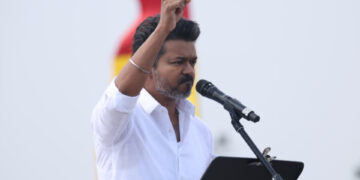
Into this cauldron steps Vijay, the charismatic leader of Tamilaga Vettri Kazhagam (TVK), whose star power now collides with political gravity. The September 27 stampede at his Karur rally—claiming 40 lives, including 10 children—casts a long shadow over his campaign. Tamil Nadu police file charges against TVK officials for negligence, rejecting claims of stone-pelting as the trigger. Undeterred, Vijay presses on with his statewide tour, vowing a “corruption-free” administration and positioning TVK as the anti-DMK force. “The 2026 contest is between us and them—no alliances,” he declares from Nagapattinam, slamming both DMK and BJP for mishandling fishermen arrests by Sri Lanka. Political strategist Prashant Kishor predicts TVK could snag 118 seats solo, a bold forecast amid surveys showing Vijay’s approval at 18%—second only to Stalin’s.
The opposition landscape fractures further. The All India Anna Dravida Munnetra Kazhagam (AIADMK), under Edappadi K. Palaniswami, allies with the Bharatiya Janata Party (BJP) in a bid to consolidate anti-DMK votes after their 2024 Lok Sabha wipeout. Palaniswami’s “Makkalai Kaappom” tour blankets 234 constituencies, railing against DMK “misrule.” Union Home Minister Amit Shah envisions an NDA government by 2026, branding DMK the “most corrupt.” Yet, BJP state chief K. Annamalai faces internal headwinds, with recent chatter hinting at his ouster.
DMK allies, including Congress and Viduthalai Chiruthaigal Katchi (VCK), demand more seats but prioritize unity against the “right-wing threat.” VCK’s Thol Thirumavalavan warns of coalition governance’s rise, while smaller players like Naam Tamilar Katchi eye vote splits.
Analysts warn of a hung assembly, with anti-incumbency potentially capping DMK at a slim majority unless scandals erupt. “Tamil Nadu’s politics mirrors its society—vibrant yet polarized,” says political scientist R. Ramasubramanian. “The 2026 vote isn’t just about seats; it’s a referendum on whether the Dravidian dream endures or evolves.”
As campaigns intensify, from Vijay’s grassroots push deploying 70,000 booth agents to Palaniswami’s constituency blitz, one truth emerges: Tamil Nadu stands at a crossroads. The elections promise not merely a change in guard, but a turning point to heal economic wounds, bridge social divides, and reclaim a vision of inclusive progress. In a state where cinema and caste have long scripted the narrative, 2026 could rewrite the ending—or expose its flaws.