




















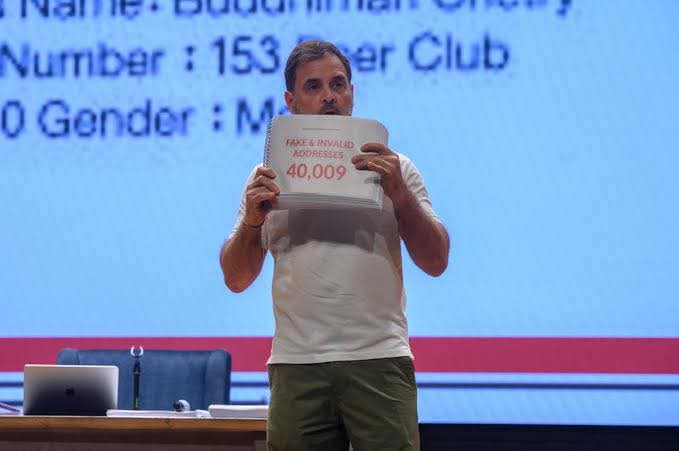
New Delhi, August 10, 2025 — In a scathing critique of India’s electoral process, Congress MP and Leader of Opposition in the Lok Sabha, Rahul Gandhi, has accused the Election Commission of India (ECI) of orchestrating large-scale “vote theft” to favor the ruling Bharatiya Janata Party (BJP). In a press conference held on August 7, 2025, Gandhi presented what he described as “open and shut proof” of voter fraud, igniting a fierce political controversy and raising serious questions about the integrity of India’s democratic institutions.
Gandhi’s allegations center on the Mahadevapura Assembly segment in Karnataka’s Bangalore Central Lok Sabha constituency, where he claimed an independent investigation by the Congress party uncovered over 1.04 lakh manipulated voter entries. These included duplicate voters, fake addresses, bulk registrations, and invalid photographs, allegedly designed to skew election outcomes. “This is not just an electoral scam; it is a major betrayal of the Constitution and democracy,” Gandhi stated in a video posted on X on August 8, warning of severe consequences for those involved.
The Congress leader cited specific instances of electoral discrepancies in multiple states, including Maharashtra, Haryana, Karnataka, Uttarakhand, Madhya Pradesh, and Chhattisgarh. He referenced a 2024 Lok Sabha election analysis in Karnataka, where Congress expected to win 16 seats but secured only nine, attributing the shortfall to manipulated voter lists in key constituencies. Gandhi also raised concerns about the ongoing Special Intensive Revision of voter rolls in Bihar, ahead of the state’s assembly elections, warning that such practices could disproportionately disenfranchise marginalized communities.
In response, the ECI has firmly rejected Gandhi’s claims, labeling them “baseless” and “irresponsible.” In a statement on August 7, the Commission demanded that Gandhi either substantiate his allegations with a signed declaration under Rule 20(3)(b) of the Registration of Electors Rules, 1960, or issue a public apology. The ECI cited a 2018 case involving former Madhya Pradesh Congress chief Kamal Nath, where similar allegations were dismissed by the Supreme Court, to argue that Gandhi’s claims lack legal grounding. The Commission also clarified that electoral rolls are prepared transparently and shared with political parties, noting that Congress failed to raise formal objections during the revision process in 2024.
The Karnataka Chief Electoral Officer further challenged Gandhi’s evidence, specifically refuting a claim that a voter, Shakun Rani, had cast her vote twice. A preliminary inquiry found no such irregularity, and the ECI requested Gandhi to provide supporting documents for a detailed probe. Gandhi, however, dismissed the demand for an affidavit, asserting that his public statements as a parliamentarian constituted an oath. “I am saying it to the people publicly; take it as an oath,” he retorted, accusing the ECI of colluding with the BJP and destroying evidence by limiting CCTV footage retention to 45 days.
The controversy has drawn sharp reactions from both sides of the political spectrum. Congress leaders, including party president Mallikarjun Kharge and Karnataka Chief Minister Siddaramaiah, have endorsed Gandhi’s allegations, with the latter announcing that the state’s Law Department would investigate the claims. The Congress has also planned a nationwide campaign to raise awareness about alleged voter list manipulation, starting with a protest march in Bengaluru’s Freedom Park on August 8.
Conversely, the BJP has dismissed Gandhi’s accusations as “bogus” and a reflection of Congress’s frustration over electoral losses. Union Minister Dharmendra Pradhan labeled Gandhi a “bayan bahadur” (someone who makes tall claims), while Maharashtra Chief Minister Devendra Fadnavis called the allegations baseless, accusing Congress of undermining constitutional institutions. BJP leaders have further argued that Gandhi’s claims insult voters and lack credible evidence, urging him to pursue legal channels like election petitions in High Courts.
The escalating feud has spotlighted broader concerns about public trust in India’s electoral system. Constitutional experts note that post-election grievances, such as those raised by Gandhi, must be addressed through judicial processes rather than public accusations, as the ECI’s authority is limited after results are declared. The controversy also underscores ongoing debates about electoral transparency, including demands for machine-readable voter rolls and longer retention of polling booth footage.
As India approaches critical state elections in Bihar and beyond, Gandhi’s allegations have amplified calls for electoral reform. On X, he reiterated his demand for transparent voter rolls, stating, “Vote Chori is an attack on the foundational idea of ‘one man, one vote’. A clean voter roll is imperative for free and fair elections.” The Congress’s planned campaign aims to mobilize public support for these demands, framing the issue as a fight to “save democracy.”
With both sides entrenched, the row threatens to deepen political polarization and test the resilience of India’s democratic institutions. Whether Gandhi’s “atom bomb” of evidence will hold up under legal scrutiny or fizzle out as political rhetoric remains to be seen, but the debate has undeniably struck a nerve in the world’s largest democracy.