




















Sleep Deprivation Pushes the Human Brain to Its Limits, Scientists Warn
By Samaran
Founding Editor, WorldNow.Co.In
Sleep is often treated as a luxury in modern life, but science is increasingly clear: sleep is a biological necessity. Decades of neurological and psychological research show that when the human body is deprived of sleep, the brain begins to fail in predictable, measurable, and potentially dangerous ways.
Researchers studying sleep deprivation have mapped out what happens to the brain as wakefulness extends beyond normal limits. The findings reveal a steady decline in cognitive control, emotional stability, and perception of reality.
After 24 hours without sleep
Just one full day without sleep is enough to significantly impair brain function. Attention span drops sharply, reaction times slow, and decision-making becomes unreliable. People often report mental fog, clumsiness, forgetfulness, and difficulty concentrating.
Scientific studies have shown that staying awake for 24 hours can impair cognitive performance to a level comparable to alcohol intoxication. The brain struggles to regulate impulses, maintain focus, and process information accurately, increasing the risk of errors and accidents.
After 48 hours without sleep
After two days without rest, the effects intensify. The brain begins to enter brief, uncontrollable shutdowns known as microsleeps—seconds-long episodes where the brain momentarily falls asleep, often without the person realizing it.
At this stage, anxiety and irritability rise, emotional control weakens, and mood swings become common. Memory, judgment, and problem-solving abilities deteriorate rapidly, making even routine tasks feel exhausting and confusing.
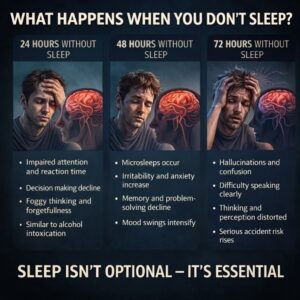
After 72 hours without sleep
By the third day, normal brain function becomes severely compromised. Many individuals experience hallucinations, distorted perceptions, confusion, and difficulty speaking clearly. The brain struggles to distinguish reality from imagination.
The risk of serious accidents increases dramatically, particularly during activities such as driving or operating machinery. Prolonged sleep deprivation at this level can pose a serious threat to personal and public safety.
Why sleep matters
Sleep allows the brain to reset and recover. During rest, brain cells repair themselves, metabolic waste is cleared, memories are consolidated, and emotional regulation systems are stabilized. Without sleep, communication between different brain regions breaks down, leading to cognitive and emotional dysfunction.
While individual tolerance to sleep loss may vary, scientists emphasize that the overall pattern remains consistent: the longer the deprivation, the greater the risk.
Sleep, researchers conclude, is not optional. It is essential for mental health, physical safety, and long-term survival.