















 Sets New Benchmarks in Global Cosmetic Education and Women Empowerment](https://worldnow.co.in/wp-content/uploads/2026/05/FB_IMG_1779691614478-360x180.jpg)




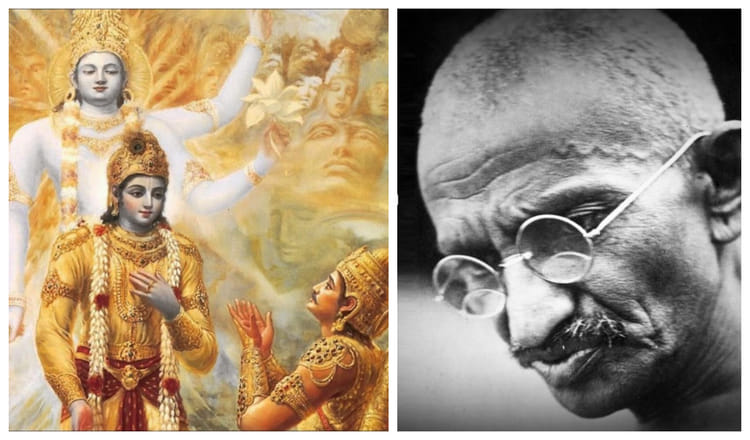
Why Mahatma Gandhi Was So Inspired by the Bhagavad Gita
— Research-Based Spiritual News Article
Mahatma Gandhi’s lifelong engagement with the Bhagavad Gita was not incidental but foundational to both his inner spiritual life and his outward social and political activism. For Gandhi, the Gita was more than an ancient scripture—it was a “spiritual dictionary,” “eternal mother,” and practical guide for ethical living amid life’s deepest challenges.
Gandhi first encountered the Gita in 1890 during his student years in England, reading Sir Edwin Arnold’s The Song Celestial. The philosophical concepts of non-attachment (anasakti) and equanimity (samabhava) made an immediate impression on him. These ideas helped shape his fundamental belief that one should act according to duty (dharma) without attachment to personal gain or fear of loss—a principle he later embedded at the core of his philosophy of satyagraha (truth-force).
Central to Gandhi’s inspiration was the Gita’s teaching on selfless action (nishkama karma). The Gita advocates performing one’s duty with full commitment but without desire for the fruits of that action. Gandhi interpreted this as a spiritual roadmap for staying focused on moral goals, rather than on ego or success. This perspective enabled him to remain steady through repeated hardships during India’s struggle for independence and encouraged others to adopt uncompromising truth (satya) and nonviolence (ahimsa) as core ethical principles.
Gandhi’s personal reflections repeatedly affirm the Gita’s central role in his life. He wrote that in moments of doubt or sorrow, he turned to verses of the Gita, finding solace and renewed purpose. He memorized key passages and lived by them, treating the text not as abstract philosophy but as a living ethical guide that informed every aspect of his conduct.
Beyond personal consolation, the Gita shaped Gandhi’s vision of universal human dignity and inner freedom. Its message of seeing the divine in all beings underpinned his insistence on equality, religious pluralism, and service to the poorest. By interpreting the Gita’s dialogue between Krishna and Arjuna as metaphorical for the inner spiritual battle in every person, Gandhi transformed an ancient discourse into a practical ethic of courage, compassion, and nonviolent resistance that resonated far beyond India.
In this way, the Bhagavad Gita became for Gandhi not just a spiritual reference but the moral engine of his life and work, guiding him with timeless wisdom toward truth, peace, and human upliftment.

 Sets New Benchmarks in Global Cosmetic Education and Women Empowerment](https://worldnow.co.in/wp-content/uploads/2026/05/FB_IMG_1779691614478-120x86.jpg)