















 Sets New Benchmarks in Global Cosmetic Education and Women Empowerment](https://worldnow.co.in/wp-content/uploads/2026/05/FB_IMG_1779691614478-360x180.jpg)



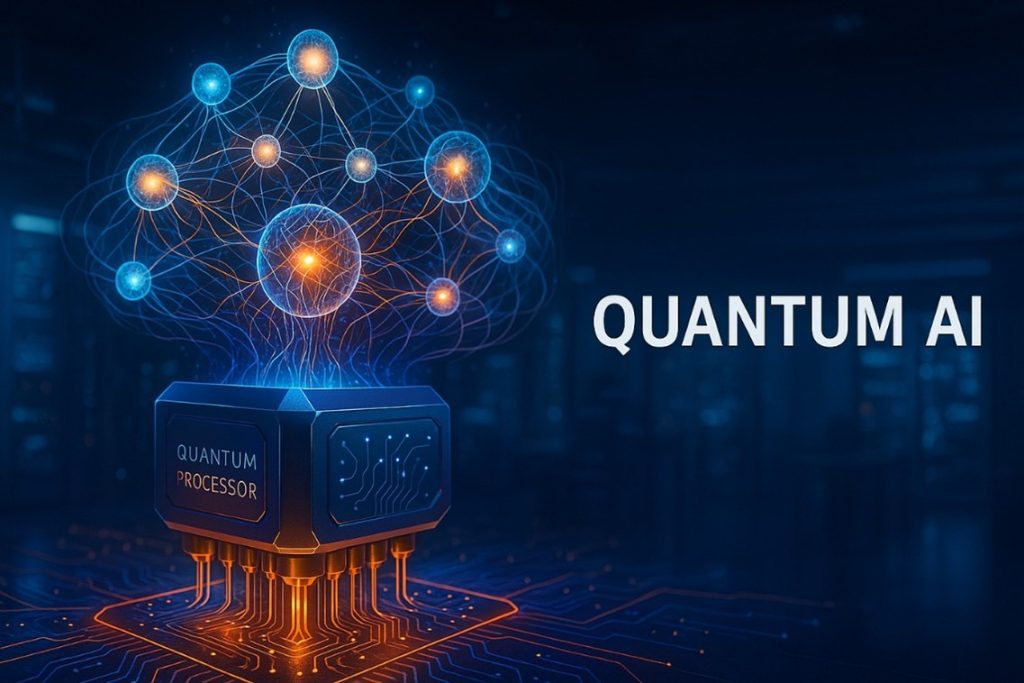
Quantum AI: The Next Civilisational Leap in Intelligence
In the long arc of human progress, moments arrive when technology does not merely improve life but redefines the idea of intelligence itself. Quantum AI stands at such a moment. It is not an incremental upgrade to Artificial Intelligence, but a convergence that could fundamentally alter how machines think, learn, and decide.
At its core, Quantum AI represents the fusion of quantum computing with artificial intelligence systems—two of the most transformative technologies of the 21st century. While classical AI relies on binary logic and massive data processing, quantum AI explores a radically different computational universe, governed by the laws of quantum physics.
Beyond Binary Intelligence
Traditional computers operate on bits—either 0 or 1. Quantum computers, however, function using qubits, which can exist in multiple states simultaneously through a phenomenon known as superposition. Combined with quantum entanglement, this allows quantum systems to evaluate vast solution spaces in parallel.
For AI, this shift is profound. Problems that currently take years of computation—complex optimisations, probabilistic modelling, and pattern recognition across enormous datasets—could theoretically be solved in minutes or seconds.
This is not speed alone; it is a new architecture of reasoning.
Redefining Machine Learning
Quantum AI challenges the very foundations of machine learning. Classical AI learns by iterative approximation. Quantum-enhanced algorithms, by contrast, may explore many possible outcomes at once, allowing faster convergence and deeper insight.
Researchers are already experimenting with:
- Quantum-enhanced neural networks
- Quantum support vector machines
- Quantum optimisation models for decision-making
While these systems remain largely experimental, their promise lies in tackling problems classical AI struggles with—high-dimensional uncertainty, chaotic systems, and non-linear optimisation.
AI Helping Quantum Systems Think
The relationship is not one-sided. Artificial Intelligence is now being deployed to stabilise and control quantum hardware itself. AI models are used to:
- Reduce quantum noise
- Improve error correction
- Optimise quantum circuit design
- Manage real-time quantum experiments
In effect, AI is teaching quantum machines how to function, while quantum systems prepare to elevate AI beyond its current limits.
Strategic and Geopolitical Implications
Quantum AI is not merely a scientific pursuit; it is a strategic technology. Nations investing heavily in quantum research—such as the United States, China, and members of the European Union—recognise its implications for:
- Cryptography and cybersecurity
- Defence simulations
- Financial systems
- Climate modelling
- Drug and materials discovery
Whoever leads in Quantum AI will shape the next global power structure—not through weapons alone, but through control of intelligence itself.
The Reality Check
Despite the excitement, Quantum AI is still in its infancy. Current quantum computers operate in what scientists call the NISQ era—Noisy Intermediate-Scale Quantum systems. They are fragile, error-prone, and limited in scale.
The immediate future, therefore, lies in hybrid intelligence systems, where classical AI and quantum processors work together rather than replace one another.
A Philosophical Turning Point
More than a technological milestone, Quantum AI raises deeper questions. If intelligence can emerge from probabilistic states and quantum uncertainty, then human cognition itself may need re-examination. Consciousness, creativity, and intuition—once considered uniquely human—may find new analogues in quantum-informed machines.
As with every powerful technology, the question is not just what Quantum AI can do, but who controls it, and for what purpose.
The coming decade will determine whether Quantum AI becomes a tool for collective human advancement—or a concentrated instrument of power.
History will remember this period not as the age when machines became faster, but as the moment when intelligence itself entered a quantum phase.
 Sets New Benchmarks in Global Cosmetic Education and Women Empowerment](https://worldnow.co.in/wp-content/uploads/2026/05/FB_IMG_1779691614478-350x250.jpg)